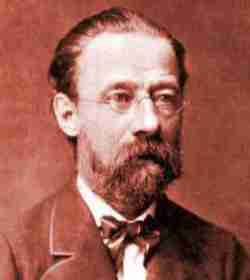
Bedřich Smetana was a Czech composer regarded in his own country as the father of Czech music. He was born on 2nd March 1824 in Litomysl, Czechia and died on 12th May 1884 in Prague, Czechia aged 60.
Major Works
“The Brandenburgers in Bohemia” (1863)
“Prodaná Nevěsta” (The Bartered Bride) (1866)
“Má Vlast” (1879)
String Quartet No. 2 (1883)
Biography Timeline
1824: Bedřich Smetana was born on 2nd March in Litomyšl, Bohemia, part of the Hapsburg Empire and German speaking. (now Czechia). His father František Smetana was a brewer and played the violin in a string quartet. His mother, Barbora, was a dancer and the third wife of his father. He was their eldest son and third child.
1829: His father teaches him the violin and he plays in a Haydn Quartet at the age of five.
1830: He makes his debut as a pianist in Litomyšl’s Philosophical Academy, playing the overture to Daniel-François Auber’s “La Muette de Portici” (The Mute Girl of Portici).
1831: The family move to Jindrichuv Hradec in southern Bohemia and Smetana goes to the local primary and Gymnasium schools. He also studies the violin and piano and begins his own compositions such as the dance “Kvapiček” (Little Galop).
1835: His father retires to Ruzkovy Lhotice Castle and Smetana is sent to the gymnasium school in nearby Jihlava. He then transfers to the religious school at Nemecky Brod where he is much happier.
1839: He enrols at Prague’s Grammar School and is taught by Josef Jungmann, a poet and leading figure in Czech nationalism. He is mocked by his classmates for his country manners and begins skipping lessons. He attends concerts and joins a local string quartet and composes pieces for them. He sees Franz Liszt play a concert and is enthralled.
1840: His father finds out he is skipping school and asks his uncle, Josef Smetana, a schoolteacher in Pilsen, to supervise his final education.
1843: He finishes school in Pilsen and has a hectic social life playing the piano at the many soirees in the town. He meets Kateřina Kolářová and is smitten. He composes several pieces for her including two quadrilles. In August he returns to Prague after Kateřina’s mother introduces him to Josef Proksch, the head of the Prague Music Institute (where Kateřina is studying).
1844: He becomes more interested in composition than piano performances. Katerina charms Proksch in delaying payment for teaching him composition until he can afford it. He is recommended for the post of live-in music teacher to the family of Count Leopold Thun by the Director of Prague Conservatoire. He is introduced to the works of both Franz Liszt and Hector Berlioz by Proksch and he composes his own G minor Piano Sonata.
1846: He sees concerts in Prague by Berlioz and probably meets him at a reception hosted by Proksch. He meets Robert Schumann and Clara Schumann at Count Thun’s home, however they think his music too influenced by Berlioz.
1847: He decides to start a music school in Prague and resigns from the Thun household leaving Katerina to take over. He then sets off on a concert tour of Western Bohemia.
1848: Early in the year Smetana writes to Franz Liszt asking him to accept the dedication of “Six Characteristic Pieces” and asks for a loan of money. Liszt accepts the dedication and endeavours to find a publisher for the work but does not give him any money. The music school opens in August with twelve students. During the 1848 Revolution he writes a series of patriotic marches dedicated to the Czech National Guard and the Students’ Legion of the University of Prague as well as “The Song of Freedom”. In June the city comes under attack from the Austrian forces and Smetana helps man the barricades on the Charles Bridge. Although the uprising is crushed, he avoids imprisonment. During this time, he meets Karel Sabina who would later write two libretti for his operas.
1849: The music school relocates to Kateřina’s parents’ home and welcomes important visitors including Liszt himself and the former Austrian Emperor Ferdinand. On 27th August he marries Katerina.
1850: He accepts the post of Court Pianist in Ferdinand’s Castle in Prague as well as teaching at the school. He continues to compose works such as “Wedding Scenes”, “Album Leaves” and a number of polkas.
1853: He begins work on his first major orchestral piece, the “Triumphal Symphony” in honour of the wedding of Emperor Franz Joseph. Unfortunately, it is rejected by the court so he hires the Konvikt Hall in Prague for its first performance on 26th February. It is not popular with the audience and is a financial failure.
1854: In July Gabriela, his second daughter, dies of tuberculosis.
1855: Katerina herself begins to show signs of tuberculosis and his daughter Bedriska dies of Scarlet Fever. Smetana writes his Piano Trio in G minor as a tribute to her, however at its first performance in Prague on 3rd December it is not well received by the audience.
1856: He writes his first symphonic poems and accepts an offer from the Göteborgs Harmoniska Sällskap (Gothenburg Society for Classical Choral Music) in Sweden to become their conductor. His daughter Katerina dies in June.
1857: In June his father dies and on his return to Prague he finds his wife Katerina in very poor health. In the autumn they both return to Gothenburg. Smetana had made a brief visit to see Franz Liszt in Weimar beforehand where he attended the concert of Liszt’s Faust symphony.
1858: He completes the symphonic poem “Richard the Third” and then begins to write “Wallenstein’s Camp”, based on the work by Friedrich Schiller and “Hakon Jarl”, a symphonic poem based on the drama by Adam Oehlenschlager, the Danish poet. He also writes “Macbeth and the Witches”.
1859: His wife Katerina dies of tuberculosis on 19th April at Dresden. Smetana goes to stay with his younger brother Karel, and falls in love with Karel’s sister-in-law Barbora (Bettina) Ferdinandiová. He proposes to her and then returns to Sweden.
1860: The marriage takes place on 10th July 1860 and Smetana and his new wife return to Sweden for a final season.
1861: Smetana and Bettina return to Prague. The Provisional Theatre National Opera house dedicated to Czech language plays and operas is opened and he helps make it a success despite opposition from the anti-Wagner block. The job of conductor is given to Jan Nepomuk Mayr as the authorities see Smetana as a dangerous modernist. His daughter Zdenka is born in September. He starts wrting an opera entitled “The Brandenburgers in Bohemia” for a competition, organised by Count Jan von Harrach, for the best comic and historical operas based on Czech culture.
1862: He conducts performances of “Richard the Third” and “Wallenstein’s Camp” in January at Zofin Island although neither are particularly successful with the audience.
1863: He completes “The Brandenburgers in Bohemia” He is now the conductor at the Provisional theatre and perfoms “The Three Riders and The Renegade”. In March he is elected president of the music section of Umělecká Beseda, (society for Czech artists). In July he begins work on a light comedy called “The Bartered Bride”.
1864: He is appointed the music critic of the Czech-language newspaper “Národní Listy”. His daughter Bozena is born. On 23rd April he conducts Hector Berlioz’s “Romeo and Juliette” symphony at the tercentenary celebrations for Shakespeare’s birthday as well as his own “March for the Shakespearean Festival”. He is unsuccessful in becoming the Director of the Prague Conservatory as he is still seen as a Lisztian radical.
1866: “Braniboři v Čechách” (The Brandenburgers in Bohemia) is finally performed in Prague on 5th January and is quickly followed on 30th May by the premiere of “The Bartered Bride”. Due to the threat of invasion by the Prussians the audiences are small but receive both well. Smetana himself escapes Prague until September when all threat of hostilities has ceased. He is appointed principal conductor of the Provisional Theatre.
1868: On 16th May he helps to lay the foundation stone for the future National Theatre and performs his “Festive Overture” at the ceremony. His next opera “Dalibor” is performed on the same evening at the New Town Theatre but is not a success with the critics.
1870: “The Bartered Bride” is performed to a packed house in September at the Provisional Theatre and is a popular public success where it has remained ever since.
1871: In January “The Bartered Bride” is performed in St Petersburg, Russia to a hostile reception from the newspaper.s Smetana put this down to his feud with the composer Mily Balakirev over his previous performances of works by Glinka.
1872: A petition to remove Smetana from the conductorship is started but with the help of supporters including Antonin Dvorak he retains his position.
1873: In January he is reappointed with a bigger salary. He begins work in his fifth opera “The Two Widows”.
1874: “The Two Widows” receives its premiere. He begins composing “Ma Vlast” (My Country) a cycle of symphonic poems. His health is now in decline due to herditary syphilis and he begins to realise he is going deaf. He is totally deaf by the end of the year and resigns as conductor of the Prague Opera.
1875: His marriage to Bettina suffers due to money worries and he moves in with his eldest daughter Zofie in Jabkenice. “Vyšehrad” and “Vltava”, parts of “Ma Vlast”, are performed in Prague.
1876: He composes the operas “The Kiss” and the string quartet “Z Mého Zivota” (From My Life).
1878: He composes the opera “The Secret”.
1879: He finally completes “Má Vlast”, although the complete cycle is not performed until 1882, and the comic opera “The Devil’s Well”.
1880: On 4th January, a special concert is held in Prague celebrating the fiftieth anniversary of his first public performance. Smetana plays his Piano Trio in G minor.
1881: His next opera, “Libuše” about the triumph of the Czech people is first performed at the opening of the new National Theatre in Prague on 11th June and he is called onto the stage for several encores.
1882: “Čertova Stěna” (The Devil’s Wall) is premiered in May and is harshly criticised by his enemies. “The Bartered Bride” is given its one hundredth performance. He is very ill during the winter.
1883: He begins writing a new opera, “Viola”, based on Shakespeare’s “Twelfth Night”. In October his odd behaviour at a reception in Prague worried his friends. Smetana had helped raise funds for the Prague theatre which had been destroyed by fire and it reopens on 18th November with a performance of “Libuše”.
1884: In February he loses his wits and becomes violent. In March a gala concert and banquet is arranged to honour his 60th birthday but he is too ill to attend and in April he suffers a total mental collapse. On 23rd April his family, send him to the Kateřinky Lunatic Asylum in Prague.
Bedřich Smetana died on 12th May 1884 in Prague, Czechia, of senile dementia although his family suspected syphilis. His funeral took place on 15th May at Tyn Church in the Old Town and he was buried in the Vysehrad Cemetery in front of a large crowd.
Influences
Bedřich Smetana’s father was an amateur violinist and fostered his son’s early interest in music. He discovered the works of Wolfgang Amadeus Mozart and Ludwig van Beethoven as a child and their music played a major role in his early years. He was a gifted child prodigy, playing in a string quartet at the age of five and playing the piano for the Emperor of Austria aged six. He later studied in Prague with the blind pianist and composer Joseph Proksch who provided a formal foundation and encouraged him to explore the works of the Romantic composers.
A major influence on him was the work of Franz Liszt which inspired him to compose symphonic poems and adopt more progressive musical techniques. This can be seen in works such as “Má Vlast” where his harmonic ideas, derive from a single theme. Another influence was Richard Wagner, despite opposition from some of his anti new music contemporaries. He used Wagner’s dramatic orchestration and leitmotifs (recurring musical themes associated with specific ideas or characters). Hector Berlioz is also recognised as a key influence on him and he was “overwhelmed by the revolutionary quality” of Berlioz’s music, such as “Symphonie Fantastique”. He heard Berlioz conduct in Prague in 1846.
To a lesser extent he was influenced by Frédéric Chopin and Robert Schumann as a pianist and was inspired by Chopin’s use of national dances. This led him to use Czech dance forms like the polka along with other Bohemian folk music and events from Czech history and legends in his own work. He became known as a nationalist composer especially during the Czech National Revival and political awakening under Austro-Hungarian rule in the nineteenth century. The twentieth century musicologist John Tyrrell has stated that his reputation as the father of Czech music and the tragic circumstances of his last years, have affected the objectivity of assessments of his work. Other composers from the “traditionalist” group such as Gioachino Rossini, Domenico Gaetano Maria Donizetti, GiuseppeVerdi and Giacomo Meyerbeer also had an influence on his work.
He was also inspired by literary works such as Friedrich Schiller’s “Wallenstein” trilogy and composed a symphonic poem entitled “Wallenstein’s Camp”. Despite the approval of Liszt, the public’s lack of enthusiasm for his music was a principal factor behind his self-imposed exile in Sweden and led to his remark that he was a “prophet without honour” after the nearly empty hall at the premiere of “Wallenstein’s Camp” at Žofín Island in January 1862. His operas fared better and “The Bartered Bride” became an enduring popular work. In his final decade despite his sudden deafness (probably caused by syphilis) and increasing ill-health he belatedly received national recognition. He also endured tragic personal events, such as the loss of his daughter which is reflected in the music of his Piano Trio in G Minor.
He has had a major influence on succeeding generations of composers such as his friend Antonín Dvořák, Leoš Janáček and Bohuslav Martinů. The composer and violinist Josef Suk, who was also the grandson of Smetana’s wife, was also inspired by Smetana’s vision of composing national music.
Further Information
List of compositions by Smetana.