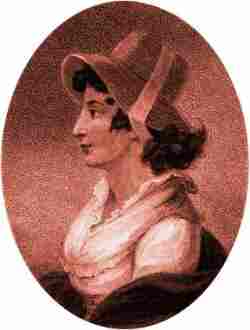
Anna Laetitia Barbauld was an English poet, essayist, literary critic, editor, and children’s author. She was born in Kibworth Harcourt, Leicestershire, England on 20th June 1743 and died in Stoke Newington, London on 9th March 1825 aged 81.
Major Works
“Hymns in Prose for Children” (1781).
“Lessons for Children” (1787-1788).
“Epistle to William Wilberforce, Esq on the Rejection of the Bill for Abolishing the Slave Trade” (1791).
Biography
1743: Anna Laetitia Barbauld was born on 20th June 1743 at Kibworth Harcourt in Leicestershire. Her father was the Reverend John Aikin, the headmaster of Kibworth School and her mother was Jane Jennings Aikin. She was educated at home in the ancient classics.
1747: Her brother John was born on 15th January.
1758: Her family moves to Warrington, Lancashire during July as her father gets a job teaching languages at the new Dissenting Academy in the town.
1761: Joseph Priestley comes to the Academy in September to teach languages and her father now moves to teach divinity.
1767: Priestley leaves the Academy and Barbauld writes “On Mrs Priestley’s Leaving Warrington”.
1769: She writes “Corsica” about the Island’s struggle for independence from France.
1770: It isbelieved that Jean-Paul Marat taught French at the Academy. He allegedly wrote to her father declaring that he wanted to become an English citizen and marry Anna.
1772: John Aikin publishes “Essays on Song-Writing” which includes some of her work. Her “Poems” are published in December.
1773: “Miscellaneous Pieces in Prose”, with work by her and her father is published.
1774: She marries Rochemont Barbauld on 26th May. He was one of the Warrington Academy’s former pupils and a clergyman six years younger than her. Rochemont was troubled with mental illness from time to time and Anna was never encouraged to marry him. The couple take over the running of Palgrave School in Suffolk with financial support from a local solicitor Philip Meadows.
1775: Barbauld publishes “Devotional Pieces”.
1778: She publishes “Lessons for Children of Two to Three Years Old” and “Lessons for Children of Three Years Old”.
1779: Barbauld publishes “Lessons for Children from Three to Four Years Old”.
1780: Her father dies.
1781: She publishes “Hymns in Prose for Children” which is considered by many people to be her best work.
1785: Death of her mother. The couple leave their school and tour France.
1786: On their return to England the Barbaulds make a home in London.
1787: She publishes “Lessons for Children” which was written for her nephew Charles Rochemont Aikin whom the Barbauld’s adopted. Barbauld’s husband becomes the Minister for the Rosslyn Hill congregation in Hampstead, London and she takes on students to earn some money. It was there that she becomes friends with the Scottish playwright and poet Joanna Baillie.
1790: She publishes “An Address to the Opposers of the Repeal of the Corporation and Test Acts” in March.
1791: She publishes “Epistle to William Wilberforce, Esq on the Rejection of the Bill for Abolishing the Slave Trade” in June.
1792: “Remarks on Gilbert Wakefield’s Enquiry into Public or Social Worship” is published in May. She writes an anti-war sermon entitled “Sins of Government, Sins of the Nation”. Her brother moves to London to avoid persecution.
1793: Her brother John publishes “Evenings at Home” with some sections by Barbauld. She publishes “Sins of Government, Sins of the Nation” in April.
1794: She edits and writes an introduction for Mark Akenside’s “Pleasures of the Imagination”.
1796: Barbauld contributes poems to Monthly Magazine which is edited by her brother.
1797: She meets Samuel Taylor Coleridge in August. She publishes “Washing Day” in December. She prefaces her edition of the poems of William Collins with an essay which is highly praised.
1798: Barbauld and Coleridge discuss Coleridge’s The Rime of the Ancient Mariner”. Barbauld said the only faults with it was that it was improbable, and had no moral to which Coleridge replied “As for the probability to be sure that might admit some question but I told her that in my judgment the chief fault of the poem was that it had too much moral, and that too openly obtruded on the reader.”
1799: “To Mr. S.T. Coleridge” is published in the Monthly Magazine in April and “A School Eclogue” is published there in August.
1802: The Barbaulds move to 113 Church Street, Stoke Newington. Anna is pleased to be near her brother. Her husband works at the Unitarian Chapel of Newington Green.
1803: She contributes work to Annual Review which is edited by her nephew Arthur Aikin.
1804: Barbauld publishes “Samuel Richardson’s Correspondence” in June. Coleridge’s view of Barbauld is soured as he thinks that some of the harsh reviews of his work in the Annual Review and Monthly Review are written by her when they aren’t.
1805: She publishes “Selections from the Spectator, Tatler, Guardian, and Freeholder, with a Preliminary Essay” in February.
1806: Her brother starts the Athenaeum after resigning from the Monthly Magazine.
1808: In January Rochemont Barbauld tries to assault Anna with a knife but she manages to jump out of a window. He takes his life by suicide by drowning in the New River in November. Anna is grief stricken by the event.
1809: She writes for the Monthly Review.
1810: “The British Novelists” is published in fifty volumes with contributions from Barbauld.
1811: She edits “The Female Speaker” and writes “Eighteen Hundred and Eleven” which is published the following year.
1812: Her poem “Eighteen Hundred and Eleven” is a satire published as a comment on freedom in her own day.
1816: She prepares an edition of poetry and prose for young women entitled “The Female Speaker”.
1822: Her brother John dies. “Poetical Thought on Death” is published.
1823: “Lines Written at the Close of the Year” is published.
Anna Laetitia Barbauld died on 9th March 1825 at Stoke Newington and was buried in the family vault in St Mary’s Church, Stoke Newington. Her “Works and A Legacy for Young Ladies” edited by her niece Lucy Aikin is published during the year.
Influences
Anna Laetitia Barbauld was influenced by the learning of the Enlightenment and in particular the works of Jean Jacques Rousseau and John Locke. Her educational work with the religious dissenting community that she and her family were part of also had a profound effect on her. She asked her father John to teach her the classics and other subjects that he would normally only teach his male pupils. She was open to the radical ideas coming from the Unitarian church and its Minister Joseph Priestley which encouraged independent thinking and her poetry reflects the beginning of the Romantic sensibility with its emphasis on individuality and imagination. Her aim was to cultivate rational and virtuous citizens through her educational classes and her writing.
She associated with a large number of reformers and radicals who were challenging the establishment and was an initial believer in the ideals of the French Revolution. Debates about slavery, human rights, and the role of women were major themes in her work and her poetry is political in nature. In her essays “An Address to the Opposers of the Corporation and Test Acts”, “Sins of Government”, “Sins of the Nation”, “Civic Sermons to the People”, “Thoughts on the Inequality of Conditions”, she outlined her hope for the strengthening of a public spirit moving towards a future age of national peace and solidarity. Her later work such as “Eighteen Hundred and Eleven” is more Romantic in tone and questions the limits of Enlightenment ideals. Her brother John Aikin was a close collaborator on “Miscellaneous Pieces in Prose” and was a major figure in her intellectual development as was her husband, Rochemont Barbauld. She lived through a major period of change from the Seven Years War and American Wars of Independence to the Napoleonic Wars through to the Industrial Revolution and the rise of the scientific method.
She was a celebrity in her lifetime and one of the most prominent literary personalities in England well known for her juvenile poetry and writings for children. Samuel Taylor Coleridge walked from Nether Stowey to Bristol in order to meet her to discuss poetry and ask for her advice and opinions. Elizabeth Montagu who hosted famous literary salons asked her to join her group and suggested she head up a women’s college and Richard Lovell Edgeworth asked her to join his literary journal written only by women. Mary Wollstonecraft labeled Barbauld as an antifeminist based upon poems such as “To a Lady” and “The Rights of Woman”.
The publication of “Eighteen Hundred and Eleven” which prophesised a British defeat put an end to her fame and she enraged critics and public alike and after that she disappeared from public view. She also offended Coleridge by criticising “The Rime of the Ancient Mariner” saying it had no moral and William Wordsworth also took against her.
Her political writings, including her pamphlets and sermons, which addressed issues like religious toleration, the abolition of slavery, and the rights of individuals contributed greatly to the wider social debate. Her editorial work and in particular her biography of Samuel Richardson and her anthology “The Female Speaker”, had a lasting impact on the literary world.
After her death she was remembered simply for her children’s books even though at the time she was described in the “Newcastle Magazine” as “unquestionably the first of our female poets, and one of the most eloquent and powerful of our prose writers”. Her adopted son Charles married Anna Letitia Le Breton, a daughter of the controversialist Gilbert Wakefield, and she wrote “Memoir of Mrs. Barbauld, including Letters and Notices of her Family and Friends” in 1874. In general, though the Victorians viewed her as “an icon of sentimental saintliness” and erased her political courage so that she became a figure that early modernists were keen to overlook. It wouldn’t be until the second half of the twentieth century that her status would rise again particularly with the advent of feminist literary criticism in the 1970’s. Even then “The Poems of Anna Laetitia Barbauld” edited by William McCarthy and Elizabeth Kraft was not published until 1994. Some critics felt that she did not fit the mould of someone who rejected the gender roles of her time and a full scale biography of her, “Anna Letitia Barbauld: Voice of the Enlightenment” by William McCarthy, was not published until 2009.
Further Information
Gutenberg online texts for Barbauld.