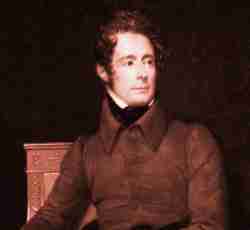
Alphonse de Lamartine was a French author, poet, and statesman. He was born in Macon, France on 21st October 1790 and died in Paris on 28th February 1869 aged 78.
Major Works
“Méditations Poétiques” (1820)
“Histoire des Girondins” (1847)
“Graziella” (1852)
“Les Visions” (1853)
“Histoire de la Turquie” (1854)
“Cours Familier de Littérature” (1856)
“Antoniella”. (1867)
Biography Timeline
1790: Alphonse Marie Louis de Prat de Lamartine was born on 21st October 1790, in Macon, France. His father was a staunchly Catholic aristocrat who was later imprisoned during the Reign of Terror. He was educated at the Jesuit college at Belley and spent his formative years on the family estate.
1806: As a young man he wants to join the army but his Royalist parents won’t allow him to serve Napoleon Bonaparte.
1812: He falls in love with a local working girl called Antoniella.
1814: His first job when the Bourbon monarchy is restored is to serve in King Louis the Eighteenth’s bodyguard.
1815: When Napoleon returns to France from exile, he flees to Switzerland but returns once the Emperor is exiled once more after the Battle of Waterloo. He learns of the death of Antoniella and will later describe her in his book “Graziella”.
1816: In October he goes to the Spa at Aix-les-Bains after a bout of ill health and there meets Julie Charles, the wife of a celebrated physician, who is also influential in Parisian literary circles. She gets him employment in the city and he dedicates some of his poetry to her.
1817: Julie Charles dies in December and he writes “Le Crucifix” in her memory.
1820: He marries the English woman Maria Ann Birch and joins the diplomatic corps, as secretary to the French Embassy in Naples, Italy. Later in the year he publishes his collection “Méditations Poétiques” which turns him into an overnight success and is hailed as a major work of Romanticism.
1821: His son is born but does not survive infancy.
1822: He publishes “Nouvelles Méditations Poétiques” and “Mort de Socrates” (Death of Socrates) which highlights his interest in metaphysics.
1825: He publishes “Le Dernier Chant du Pèlerinage d’Harold” based on Lord Byron’s “Childe Harold’s Pilgrimage”. He is made a Chevalier of the Legion d’Honneur.
1829: He is elected to the Academie Francaise.
1830: He publishes two volumes of “Harmonies Poetiques et Religieuse”. In July, when King Louis-Phillipe ascends the throne, he abandons his career as a diplomat and enters politics. He doesn’t align himself with the monarch however and points out the many current social problems.
1832: He and his wife, the painter and sculptor, now known as Marianne or Elisa de Lamartine, travel to Lebanon, Syria and the Holy Land. Their only remaining child Julia dies in Beirut on 7th December aged ten.
1833: After two previous and unsuccessful attempts he is elected to the Chamber of Deputies of France. He quickly forms his own “Social Party” and becomes a prominent critic of the July Monarchy.
1835: He publishes the “Voyage en Orient” describing his recent travels.
1836: He publishes “Jocelyn” the story of a young man who is cast out of a religious seminary during a revolution and falls in love with a young girl but is recalled to the institution and becomes a man of God serving the community.
1838: He publishes the first part of his long metaphysical poem entitled “La Chute d’un Ange” (The Fall of an Angel) which is set in the Lebanon. He is against eating animals and this poem and the 1849 work “Les Confidences” will be used by vegetarians in the Twentieth Century. He also writes a discourse saying that working class revolution is inevitable.
1839: He publishes “Recueillements Poétiques (Poetic Meditations).
1846: He publishes another political discourse and is convinced that the social question, which he calls “the question of the proletariat,” is the principal issue of his time.
1847: He publishes “Histoire des Girondins” in July which becomes very popular and promises a “revolution of scorn”.
1848: After the revolution of 24th February a Second Republic is proclaimed in France and he becomes the effective head of the provisional Government in April when he is elected to the National Assembly and made Minister of Foreign Affairs. The Bourgeoisie assume he will placate the proletariat and the army assume he will be a strong leader for them. However, he advocates universal male voting rights and the abolition of slavery in French territories and defends the use of the Tricolour Flag as a symbol of France and the Revolution. After a revolt against his policies he and his government are thrown out on 24th June. In December he stands in the Presidential election but is comprehensively beaten by Louis Napoleon Bonaparte and he retires from politics altogether.
1850: He is now enormously in debt as he had already shared his inheritance from his family with his sisters and since then was not making enough from literature to compensate.
1851: He publishes the novel “Geneviève” and begins writing“Histoire de la Restauration” which is published the following year.
1854: He publishes “Histoire des Constituants” and begins writing “Histoire de la Turquie” (published 1855).
1855: He publishes “Histoire de la Russi” (History of Russia).
1856: He is a major contributor to the periodical “Cours Familiers de Littérature” to support himself where he publishes poems such as “La Vigne et la Maison” and “Le Désert”.
1858: A subscription is raised for his benefit.
1861: He oversees the publication of an elaborate edition of his works in forty-one volumes which takes five years to complete.
1863: His wife dies on 21st May. He publishes “Mémoires Politique”.
1867: He publishes the novel “Antoniella”. The government of the Emperor Napoleon the Third vote him the equivalent of £20,000 however he is attacked by extreme Republicans for accepting it.
Alphonse de Lamartine died in virtual poverty on 28th February 1869 in Paris, France. He was buried in the Cimetière de Saint-Lazare, Montpellier, France.
Influences
Alphonse de Lamartine was important in nineteenth century French history due to being a poet, novelist and historian besides his work with government. He was a pioneer of the French Romantic movement moving literature on from classical constraints and his earliest influences as a young man were the works of Dante Alighieri, the English Poet John Milton and the Swedish Scientist Emanuel Swedenborg.
His poetry such as that found in “Poetic Meditations” was heavily influenced by the examples of Jean-Jacques Rousseau and François-René de Chateaubriand. He was a great traveller and works such as “The Fall of an Angel” of 1838 mirror his travels in the Middle East and his fascination with reincarnation and pantheism. “Graziella” of 1852 shows his deep love of the countryside of Italy and his love for Antoniella. “Poetic Meditations” describes his passion for another lady, this time Julie Charles.
Some of his poems were set to music. “Le Lac” from “Méditations Poétiques” was used by the Swiss composer Louis Niedermeyer in 1821 and later settings were created by Hector Berlioz, Charles Gounod, Camille Saint-Saëns, Georges Bizet and Claude Debussy. Franz Liszt was one of his friends from his Paris years and his 1834 work is named after the collection “Harmonies Poétiques et Réligieuses”. In 1845 Liszt proposed to his niece (and ward) Countess Valentine de Cessiat but was refused.
Many contemporaries such as Victor Hugo, Alfred de Musset-Pathay and Charles Augustin Saint-Beuve publicly admitted to admiring his poetry even if they disagreed with his politics. During his lifetime he achieved a major reputation as a poet and prose writer but by the time of his death this had waned significantly.
In 1839 he abandoned poetry for prose writing and by 1847 he had completed his work “History of the Girondists” about the French Revolution which was extremely popular with the public if not the critics. His political career reached its height in 1848 when King Louis-Phillipe was removed in a revolution and he became the president of the Second Republic’s provisional government only to be ousted in turn by Louis Napoléon. In his short term of office, he advocated for the abolition of slavery, freedom of the press and the separation of church and state. Afterwards he devoted himself purely to writing to support his family, even though he slipped further into debt having had to look after his sisters. His late work covered many social and religious themes.
After his death later generations of poets such as the Parnassians and the Symbolists ridiculed his sentimentality but even they were influenced by the musicality in his verse. Writers such as Leo Tolstoy, William Butler Yeats and the American mystical poet Hart Crane were also influenced by his work.
Today many critics agree that his prose writings were marred by hasty composition or insufficient research and have little artistic value. “Poetic Meditations” on the other hand is still regarded as an important work and a watershed between Classicism and Romanticism and “Meditations” is now regarded as the first example of French Romanticism.
Further Information
List of works by Lamartine.