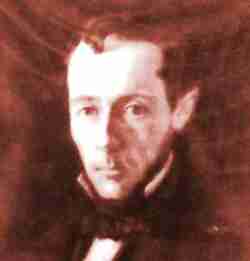
Alexandre Herculano de Carvalho e Araújo was a Portugese novelist, poet and historian. He was born on 28th March 1810 in Lisbon, Portugal and died on 13th September 1877 in Santarém, Portugal aged 67).
Major Works
“Eurico” (1844)
“História de Portugal” (1846-1853)
“Lendas e Narrativas” (Legends and Chronicles) (1851)
“História da Origem e Estabelecimento da Inquisição em Portugal” (History of the Origin and Establishment of the Inquisition in Portugal) (1854–59)
“Estudos Sobre o Casamento Civil” (Studies on Civil Marriage) (1866)
Biography Timeline
1810: Alexandre Herculano de Carvalho e Araújo was born on 28th March in Lisbon, Portugal into a humble family but was educated in Latin, logic and rhetoric at the Necessidades Monastery. He later spent a year at the Royal Marine Academy studying mathematics as he wanted a commercial career.
1828: Portugal is taken over by the absolute ruler Dom Miguel the First.
1831: He is involved in the unsuccessful military pronunciamento against Miguel during August and has to escape Portugal and take up refuge in England and France.
1832: He returns to Portugal and lands at Porto with the small army led by Dom Pedro and they besiege the city and eventually remove Miguel and set up a liberal regime. He becomes at librarian at the city archives and publishes his first book of verse “A Voz de Propheta” (The Prophet’s Voice).
1834: He publishes the book of verse “A Harpa do Crente” (The Believer’s Harp).
1837: He abandons poetry and becomes the editor of the literary review “O Panorama” where he later publishes his historical tales. He takes on the post of Royal Librarian at the Ajuda Palace in Lisbon.
1839: He begins work on “História de Portugal” (History of Portugal) and publishes “Chronicle of Dom Sebastiao”. He starts work as the librarian of the Royal Library of Ajuda.
1840: He is elected to the Cortes (parliament) representing the Cartistas (conservative Liberals) and campaigns for the reform of education.
1841: Costa Cabral establishes another authoritarian regime in Portugal and Herculano retires from politics.
1842: He publishes the historical novel “O Monge de Cister” (The Cistercian Monk).
1843: He publishes the novel “O Bobo” (The Jester”).
1844: He publishes “Eurico the Priest” which owes much to Walter Scott. It describes the fall of the Visigothic monarchy and the beginnings of the Christian Kingdoms in the Iberian Peninsula. He publishes “Annals of King Joao the Third”.
1846: He publishes the first volume of “História de Portugal” covering the early period up until 1279. It proves controversial as it dismisses several legends including Christ’s appearance to the first King of Portugal at the Battle of Ourique in 1139. He is denounced by the newspapers and is attacked by the clergy from the pulpit for his lack of patriotism and piety.
1847: The second volume of “História de Portugal” is published.
1848: He publishes “Monge de Cister” (Cistercian Monk) which concerns the reign of King Joao the First when the middle classes stood up to the nobility.
1849: The third volume of História de Portugal” is published.
1850: He writes a letter to the Cardinal Patriarch of Lisbon called “Eu e o Clero” (Me and the Clergy) which denounces the fanaticism and ignorance of the clergy and begins an unseemly pamphlet war between the two sides.
1851: His historical tales are published in the two volume “Lendas e Narrativas” (Legends and Chronicles). He takes part in the Regeneration movement which overthrows the Costa Cabral regime. He helps found two newspapers attacking political centralism and clerical influence.
1852: He becomes Mayor of Belém when the district of Lisbon achieves municipal autonomy.
1853: The fourth and last volume “História de Portugal” is published.
1854: He publishes “História da Origem e Estabelecimento da Inquisição em Portugal” (History of the Origin and Establishment of the Inquisition in Portugal) in which he states that the royal absolutism of King John the Third and clerical power were allies in the confiscation of the property of converted Jews “New Christians” via the Inquisition. He also campaigns against the restoration of monastic orders.
1856: On the death of King Pedro the Fifth one of his enemies is appointed to the national archives in Ajuda where he edits “Portugalliae Monumenta Historica” (History of Portuguese Monuments) commissioned by the Academy of Sciences of Lisbon. He co-founds the Historic Progressive Party.
1857: He opposes the Concordat of 21st February between Portugal and the Holy See.
1861: He forms a pressure group to resist Pan-Iberism which seeks to make Portugal and Spain one country.
1866: He supports civil marriage in his “Estudos Sobre o Casamento Civil” (Studies on Civil Marriage) but the work is banned by the authorities. He marries his long-time friend Mariana Hermínia de Meira. They do not go on to have any children.
1871: He becomes openly critical of the new dogmas of the Immaculate Conception of Christ and Papal Infallibility.
Alexandre Herculano de Carvalho e Araújo died on 13th September 1877 in Santarém, Portugal. He was buried in the Jeronimos Monastery at Belem, near Lisbon, Portugal.
Influences
In 1831 as a young man Alexandre Herculano took part in the unsuccessful rebellion against the absolute rule of Dom Miguel showing his commitment to liberal constitutionalism and reform. He was then forced into exile in England and France. During his political exile he was widely influenced by European Romanticism, rejecting Greco-Roman classical models in favour of medieval chronicles and native folklore. He also studied German language and culture by attending the soirées of the Marquesa de Alorna who was the Portuguese equivalent of Madame de Staël. He became so proficient that he began translating works by Friedrich von Schiller.
In 1832 he returned to Portugal with Dom Pedro’s small army (The Emperor of Brazil and Miguel’s brother). Pedro eventually ousted Miguel and established a liberal regime. Herculano was convinced that cultural reform should accompany political change and abandoned poetry to become the editor of the periodical “O Panorama” in 1837. This was a review that kept abreast of European literary and social trends and where he published his historical tales (later to be published together in two volumes as “Lendres e Narratias” (Legends and Chronicles) in 1851). He worked alongside his fellow intellectual Almeida Garrett on the periodical establishing their Portuguese Romantic-liberal literary project and Portuguese promoting national identity.
He was the first to introduce the historical novel to Portugal by directly imitating the narrative frameworks of Walter Scott. He was also influence by contemporary writers such as Victor Hugo and Alfred de Vigny and François-René Chateaubriand with their emotionally charged concepts of the historical hero.
Elected to the Cortes (parliament) in 1840, he campaigned for a democratic reform of education, but he withdrew from politics in 1841 when Costa Cabral established another authoritarian regime. The first volume of his “História de Portugal” was published in 1846. As the result of his comprehensive research in original manuscripts, he shocked many contemporaries by describing many legends as false. For example, his view that the Battle of Ourique was not won by the appearance of Jesus Christ brought a storm of protest from clergy and the national press.
In 1851 the Costa Cabral regime was overthrown by the movement of the Regeneration, in which he also took part. To combat the ultraconservative elements that sought to undermine the new regime, he helped found two newspapers attacking political centralism and clerical influence. Despite being a Catholic himself he regarded ultramontanism (the doctrine of papal supremacy over national churches) as the main enemy of liberal institutions. He campaigned against the restoration of the monastic orders and advocated civil marriage and was later highly critical of dogmas such as the Immaculate Conception and Papal Infallibility. Conversely though he condemned what he considered the immorality and irreligion of Lord Byron and the French Roman Feuilleton (A novel serialised in a periodical or newspaper).
His method of writing social history presented the people as active historical agents and his coverage of the recent past anticipated by more than a century the idea of the “histoire du temps present”. He was also actively engaged in heritage protection and the role of buildings, museums, archives and libraries. He was librarian at the Real Biblioteca Pública da Cidade do Porto (Royal Public Library of the City of Porto) and of the Royal Libraries of Ajuda and Necessidades in Lisbon. He also founded the Sociedade Propagadora dos Conhecimentos Úteis (Society for the Propagation of Useful Knowledge).
In his last years he bought a rural farm in the countryside near Santarém where he founded a farmers’ cooperative in 1877.
His work influenced a major wave of nineteenth century Portuguese writers, historians, and liberal intellectuals such as the writers Oliveira Marreca, Luís Augusto Rebelo da Silva, and Arnaldo Gama. Early works by major figures such as Antero de Quental were directly inspired by his romantic poetry, whilst sculptors like António Soares dos Reis drew conceptual inspiration from his writings. As a leading public intellectual, his defence of objective secular history and criticism of ultramontanism and clerical power set an ethical baseline for future Portuguese republicans and reformers. Members of the Geração de 70 (Generation of 70) such as José Maria de Eça de Queirós and Oliveira Martins also built upon his secular framework and liberal nationalism.
Further Information
List of works by Herculano.