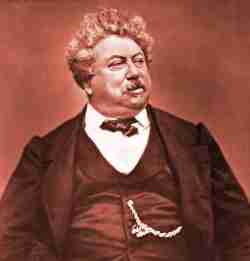
Alexandre Dumas: (also known as Alexandre Dumas père) was a French novelist and playwright. He was born in Villers-Cotterets, France on 24th July 1802 and died in Seine-Maritime on 5th December 1870 aged 68.
Major Works
“The Count of Monte Cristo” (1844).
“The Three Musketeers” (1844).
“The Man in the Iron Mask” (1845).
“The Vicomte de Bragelonne” (1847).
Biography Timeline
1802: Alexandre Dumas (originally known as Dumas Davy de la Pailleterie was born on 24th July in Villers-Cotterêts, in France. He was the son of General Thomas Alexandre Dumas Davy de la Pailetterie who was of mixed race from Saint-Domingue and Marie-Louise Labouret, the daughter of an innkeeper.
1811: He enters Abbé Grégoire’s school.
1813: He finishes school.
1816: Dumas becomes a clerk for a solicitor in Villers-Cotterêts although he is not interested in studying the law.
1819: He meets Adolphe de Leuven with whom he will write his first literary works.
1822: He visits Paris for the first time.
1823: He settles in Paris permanently and works in the office of the Duke of Orléans.
1824: His son Aleandre Dumas Fils is born on 24th July after a love affair with Laure Labay.
1825: The first performance of his play “La Chasse et l’amour” (Hunting and Loving) jointly written with Leuven takes place.
1829: “Henri the Third and his Court” is performed at the Comédie Française on 10th February and is well received by the audience.
1830: “Christine” receives its premiere on 5th March at the Theatre de l”Odeon and the income from his first two plays allows him to devote himself full time to writing. The 1830 revolution begins in France and Dumas is involved.
1831: His daughter Marie-Alexandrine is born in March to the actress Belle Kreilssamner. On 3rd May Dumas’s play “Antony” is first performed at the Theatre de la Porte Saint-Martin and it is a triumph establishing him as a major writer and he is known principally as a dramatist in France.
1832: He visits Switzerland and meets the writer François-René de Chateaubriand.
1833: “Impressions de Voyage–Suisse” is first published.
1835: He visits Italy.
1836: He writes his first novel serialised in a newspaper, “La Comtesse de Salisbury; Édouard the Third”.
1837: He publishes “Caligula“.
1838: He tours Belgium and Germany. Dumas rewrites one of his plays “Le Capitaine Paul” about the American naval officer John Paul Jones as a serial novel. His first novel is “Acte” about Agrippina, Nero, and his mistress which would later inspire “Quo Vadis” by Henryk Sienkiewicz.
1839: He writes “Celebrated Crimes”, an eight-volume collection of essays on famous criminals from European history with other friends.
1840: Dumas gets married to the actress Ida Ferrier on 1st February and they spend a holiday in Italy. “The Fencing Master”,“Impressions de Voyage-Excursions sur les Bords du Rhin” and “Souvenirs de Voyage-une Année à Florence” are published. He collaborated with Augustin Grisier, his fencing master in “The Fencing Master”. It is the story of Grisier’s account witnessing the events of the Decembrist revolt in Russia and it was consequently banned by the Tsar Nicholas the first and Dumas was prohibited from visiting the country until after his death.
1841: Publication of “Le Chevalier d’Harmental”.
1843: He writes the short novel “Georges” which uses material that he would later use again in “The Count of Monte Cristo”.
1844: He buys land in Port-Marly to have a house built. Despite his healthy earnings he always lives beyond his means and it has been estimated that he had over forty mistresses in his lifetime. He begins writing full scale novels. “LesTrois Mousquetaires”, “Une Fille du Régent” and “Le Comte de Monte-Cristo” are all written in this year.
1845: “Vingt Ans Après”, “Le Chevalier de Maison-Rouge” and “La Dame de Monsoreau” are published.
1846: He travels to Spain and then to North-Africa. “Le Bâtard de Mauléon”, “Joseph Balsamo” and “Une Fille du Régent” are published. The spacious Château de Monte-Cristo is begun at La Port-Marly complete with writing studio.
1847: In February he opens the Théâtre Historique and moves into his house in Port-Marly. “La Reine Margot”,“Impressions de Voyage”, “de Paris à Cadix”, “Les Quarante-Cinq”, “Le Vicomte de Bragelonne” are published.
1848: He fails to be elected as a Member of Parliament. “Le Collier de la Reine”, “Catiline” and “La Dame aux Camélias” are published.
1849: Château de Monte-Cristo is auctioned due to Dumas’s debts. “Les Mille et un Fantômes” and “The Testament of Caesar” are published.
1850: He is prosecuted for several debts and the Théâtre Historique is declared bankrupt. “La Tulipe Noire” and “Ange Pitou” are published.
1851: He flees to Brussels to escape prosecution by Napoleon the Third, now the ruler of France. “Olympe de Clèves” and “Mes Mémoires” are published.
1852: He travels in Germany and the Netherlands. “La Comtesse de Charny” and “Isaac Laquedem” are published.
1853: He settles his bankruptcy.
1854: He returns to Paris. “Les Mohicans de Paris” and “Le Page du Duc de Savoie” are published.
1856: “The Oresteia” is published.
1857: He travels to Guernsey where Victor Hugo is living in exile. He then tours England and Germany. “Le Meneur de Loups” is published.
1858: From June onwards, Dumas travels in Russia. “Les Louves de Machecoul” is published.
1859: He visits Italy.
1860: He travels with his mistress Emilie Cordier on a boat on the Mediterranean. He publishes “Memoirs of Horace“, in four volumes in the “Siècle Magazine” about the Roman Emperor Augustus.
1861: In March the Kingdom of Italy is proclaimed, with Victor Emmanuel II as its King. Dumas travels there and meets Giuseppe Garibaldi in Sicily and helps him in his struggle for unification and aids him in a visit to Marseille to buy arms for his soldiers. Garibaldi later appoints Dumas Chief of Excavations and Museums, in Naples. He starts the newspaper “L’Indipendente” in Naples.
1863: “La San Felice” is published.
1864: He returns to France and sets up home in Enghien.
1865: He travels in Austria and Hungary.
1866: He has an affair with Adah Isaacs Menken, an American actress.
1867: “Les Blancs et les Bleus” and “La Terreur Prussienne” are published.
1869: He begins work on his Dictionnaire de Cuisine in Brittany. “Le Docteur Mystérieux” and “La Fille du Marquis” are published.
1870: Dumas lives in his son’s house in Puys.
Alexandre Dumas died on 5th December 1870 in Puys of natural causes. He was buried at his birthplace of Villers-Cotterêts in Aisne. His “Le Grand Dictionnaire de Cuisine” was finally published in 1873 after his death. In 2002, for the bicentenary of his birth, his ashes were re-interred at the Pantheon in Paris alongside other writers.
Influences
Alexandre Dumas’s father, the Haitian born soldier Général Dumas, was an avid reader of Plutarch and Caesar. Even though he died when Alexandre was four he had instilled a love of the classics and ancient mythology in the young boy. In his memoirs the writer recalled “I was everlastingly devouring the stories”. Like his father, he used his enslaved grandmother’s last name of Dumas. His education by the Abbé Grégoire seemed to have been limited to learning Latin and in particular Virgil and Tacitus. Later in life he brought his own newspaper, “Le Mousquetaire” and published translations of Homer’s “Iliad”.
His career as a writer began under King Louis-Philippe and he wrote articles for magazines and a succession of plays. His first play in 1829 “Henry the Third and His Court” written when he was twenty-seven years old was hugely successful as was his next work “Christine” in the following year. He tried to write works which he said were accessible to the public. This gave him much needed income to continue as a full-time writer although he continued to lead an extravagant life for the rest of his life and his outgoings always exceeded his income. Scholars have worked out that he had forty mistresses which added up to a considerable expense.
In 1836 he turned his attention to writing novels and, ever the astute businessman, he serialised many of them in the newspapers of the day. He later founded a production studio employing other writers to produce hundreds of stories under his direction with his chief collaborator Auguste Maquet. The novels became so popular that they were translated into English and many other languages. He also wrote many travel books inspired by his own frequent journeys as well as numerous other works and published a total of 100,000 pages in his lifetime. He would also spend months at a time in the places where his works were to be set such as Rome, Naples, Pompeii or Herculaneum. He also maintained a deep interest in the history of Renaissance and Baroque Europe.
In 1848 he put his version of “Hamlet” onto the stage and said “O great Shakespeare, you who understood these things much better than all of our wretched professors of Roman History!” He was a major figure in the literary and creative circles of Paris and met with many other prominent authors. He was great friends with George Sand for instance. His best-known works then as now are his adventure novels such as “The Count of Monte Christo” and “The Three Musketeers” which have been translated widely and turned into film versions in the twentieth century. By romanticising French history in his novels, Dumas helped foster a sense of national pride in the years following the French Revolution.
His death at the time of the Franco-Prussian War came when his reputation had decreased in popularity. Nevertheless, his large-scale narratives, colourful characters and attention to historical detail set a precedent for later works of historical fiction and adventure novels. His books influenced countless other writers such as Jukes Verne, Gaston Leroux (the creator of the “Phantom of the Opera”) and Mark Twain. Rafael Sabatini was also inspired by his swashbuckling style as seen in works such as “Captain Blood”. In the world of science fiction and fantasy writers such as Steven Brust, Alfred Bester and Gwyneth Jones also nod to his influence.
Many writer’s were attracted to his themes of justice, loyality and vengeance and the critique of corrupt political systems and some have openly quoted his novels by name. Others took up his use of the serialised from with cliff-hanger endings to each part.
Dumas was also a champion for writers and artists of Afro-Caribbean descent. Particularly in his novel “Georges”. His works have been adapted for television and film and used in pop culture in modern times and introduced his characters to new audiences over several generations. In the twentieth century, academics such as Reginald Hamel and Claude Schopp began a critical reappraisal of his work and Hamel found an unknown five act play called “The Gold Thieves” in 2002 in the archives of the Bibliothèque Nationale de France. As late as 2005 his last novel was published entitled “The Knight of Sainte-Hermain” which features the Battle of Trafalgar. This 1869 work was completed by Schopp who added the last two chapters based on the author’s own notes. It became a best seller at the time.
Further Information
List of novels by Dumas.