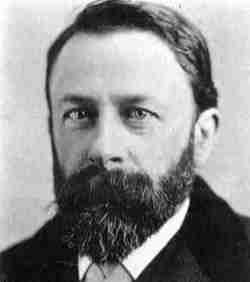
Albert Bierstadt was a German-American painter born in Germany although he moved with his family to the United States when he was one year old. He is best known for his lavish, sweeping landscapes of the American West. He was a member of the Hudson River School in New York who produced detailed work of the area. He was born on 7th January 1830 in Solingen, Rhine Province, Germany and died on the 18th February 1902 in New York aged 72.
Major Works
Staubbach Falls, Near Lauterbrunnen, Switzerland (1856)
The Rocky Mountains, Lander’s Peak (1863)
The Domes of the Yosemite (1867)
The Emerald Pool (1870)
Bahamian View (c.1880)
Biography Timeline
1830: Albert Bierstadt was born on 7th January in Solingen, Germany. He was the youngest of six children of Henry Bierstadt, a cooper, and Christina M. Tillmans.
1832: The family emigrate to New Bedford, Massachusetts, USA which had a large whaling industry and Henry’s barrels were in high demand. The young Albert becomes interested in art at an early age and begins sketching and drawing.
1848: Gold is discovered in California and there is a major increase of the population moving westwards.
1850: He advertises that he is giving painting lessons in the local newspaper.
1851: Bierstadt begins to experiment with oil paints.
1853: He exhibits at the Massachusetts Academy of Fine Arts and visits New Hampshire’s White Mountains range. He then goes to Germany to study art at the Düsseldorf School of Painting.
1857: He returns to New Bedford and takes up teaching again before devoting himself full time to drawing and painting.
1858: He exhibits at the National Academy of Design in New York City. The critics are particularly impressed with his large painting of Lake Lucerne in Switzerland. He is made an honorary member of the NAD. He moves to New York permanently and has a studio in a building in Tenth Street.
1859: Bierstadt travels west to the Rocky Mountains for the first time with Frederick W. Lander’s overland railway survey and he begins to take up the new art of photography. He sketches the scenery and the lives of the natives.
1860: He paints “Base of the Rocky Mountains” and sets up a photography business in New York City with his brothers Charles and Edward, which was to last until 1866.
1863: He embarks on his second journey to the west and visits the Yosemite Valley and the Pacific Coast accompanied by the author Fitz Hugh Ludlow. He paints “The Rocky Mountains, Lander’s Peak” which is highly praised. After their return home Ludlow and his wife Rosalie obtain a divorce leaving the way clear for Bierstadt to form a relationship with her. Later in the year he is called up for military service during the American Civil war but he pays for someone else to take his place. He is also commissioned by the US government to produce two paintings for the House Chamber in the Capitol Building in Washington DC. These became “Discovery of the Hudson” and “Entrance into Monterey”.
1864: His painting “Rocky Mountain” is exhibited at the New York Sanitary Fair.
1865: With money now coming in from his painting he is able to buy five acres of land in New York State and builds his home and studio called “Malkasten” in Irvington overlooking the Hudson River.
1866: In November he marries Rosalie Osborn Ludlow who is the divorced wife of his fellow artist and friend, Fitz Hugh Ludlow. She passed away in March 1893. They spend the next two years touring Europe. In London they are granted an audience with Queen Victoria and in Paris he is awarded the Legion of Honour. In Rome, the couple meet the composer Franz Liszt.
1868: Once back in America he makes another trip to the Yosemite and Sierra Nevada areas.
1869: The transcontinental railway is completed.
1870: Bierstadt visits New England and New Hampshire with his brother Edward. In New Hampshire he paints one of his most famous works “Emerald Pool”. By now he has become linked with second-generation Hudson River School who chose locations far away from the Hudson area.
1871: He visits San Francisco in July on the new transcontinental railway.
1873: He returns to New York in October and finally finishes “Discovery of the Hudson”.
1875: “The Discovery of the Hudson” is displayed for the first time in the United States Capitol Building.
1876: He is a guest of President Rutherford B Hayes in the White House. In the autumn Rosalie is diagnosed with tuberculosis and is advised by her doctor to move somewhere warmer. The Bierstadt’s stay in the Bahamas during the winter months where he paints local tropical landscapes and seascapes. Bierstadt’s work for the 1876 Philadelphia Centennial was however not well received and marks a turning point in his career.
1878: He paints “The Shore of the Turquoise Sea”.
1880: “The Shore of the Turquoise Sea” is exhibited at the National Academy of Design in New York and is his last major exhibition.
1881: He travels to the Yellowstone Park for the first time.
1882: His house, Malkasten, burns down and many of his paintings are lost.
1886: He fills a whole room at the Industrial Exposition in Minneapolis.
1889: Bierstadt submits “The Last Buffalo” for the Paris Exposition Universelle and “The Landing of Columbus” for World’s Columbian Exposition but both are rejected.
1893: His wife Rosalie dies. Rosalie in March.
1894: He marries a wealthy widow, Mary Hicks Stewart, the widow of David Stewart, a banker from Boston.
1895: Due to his extravagant lifestyle he has to declare bankruptcy. He sells his property and 150 paintings to pay his creditors.
Albert Bierstadt died suddenly on 18th February 1902 in New York City and is buried at the Rural Cemetery in New Bedford, Massachusetts beside his parents.
Influences
Albert Bierstadt was largely self-taught however, in 1853 he travelled to Dusseldorf, in Germany to study art in more detail. Whilst there he trained in the Academy under Emanuel Leutze, the well-known history painter who is known for his works such as “Washington Crossing the Delaware” now in the Metropolitan Museum of Art in New York. He lived in Germany for four years and was exposed to European mountain traditions and the precise technical skills used by painters in Germany and elsewhere as well as the whole Romantic tradition.
After returning to New York, he joined The Hudson River School, which included artists such as Asher B. Duran and Frederic Edwin Church, and adopted their style of using dramatic lighting and spectacular natural scenes. He became known for painting massive canvases almost ten feet tall and fifteen feet wide which were designed to make viewers feel they were actually in the landscape. In 1859, he joined a United States Government expedition surveying the west of America led by Colonel Frederick W. Lander. There he filled several notebooks with views of the Rocky Mountains. Other later visits with Fitz Hugh Ludlow would add many raw sketches and photographs to his collection. His second trip, in 1863, was to Yosemite and he visited Yellowstone National Park in 1881 and 1883.
Back in the studio he would paint his own interpretations of the landscapes which were done for maximum dramatic effect and in later years he was pilloried by the critics for being excessive and taking liberties with the views. Whilst his individual trees and rocks looked accurate and convincing his final studio canvases prioritised emotional impact over the accuracy of the view.
In his heyday he fulfilled the desire by the public to see images of the west. He was a canny businessman and a master of self-promotion. He would paint pristine wildernesses or pioneer families on the trail to order depending on what the buyer desired and his exhibitions were treated like theatrical events with tickets sold for the crowds. All of this gained him immense wealth. In 1865 his masterpiece “The Rocky Mountains, Lander’s Peak” sold for $25,000 which was an all-time record for an American artwork at the time. He increasingly used symbols in his paintings to convey complex messages about American subjects. In his early period, he often included Native Americans but was rebuked by critics and responded by portraying animals such as bison instead.
Such was his fame that he had a 14,110-foot mountain in Colorado named after him and in 1867 he travelled to London where he held a private exhibition for Queen Victoria and her son the Prince of Wales. His paintings spurred tourism to the American West and may have influenced Congress to protect Yosemite as a national park. He was also a charter member of the Boone and Crockett Club, the first natural conservation group in the country. In 1888 he began work on two major paintings, both titled “The Last of the Buffalo”. These works highlighted the decimation of bison in Yellowstone National Park.
By the late 1880’s and 1890’s artistic tastes were changing as more modern trends like Impressionism took hold. He began to look old fashioned and his work lost its appeal to buyers. Although he had painted over five hundred works, he died largely forgotten and almost bankrupt. Nevertheless, he influenced many on the myth of what the Wild West looked like and even early photographers followed his compositional style and theatrical lighting.
It was not until the 1960’s that interest in his work was renewed when there was an exhibition of his small oil studies in America. Modern critics are divided. Some have seen his work as gaudy, extravagant and soulless whilst others praise his influence on the conservation movement.
Further Information
Examples of paintings by Bierstadt.